
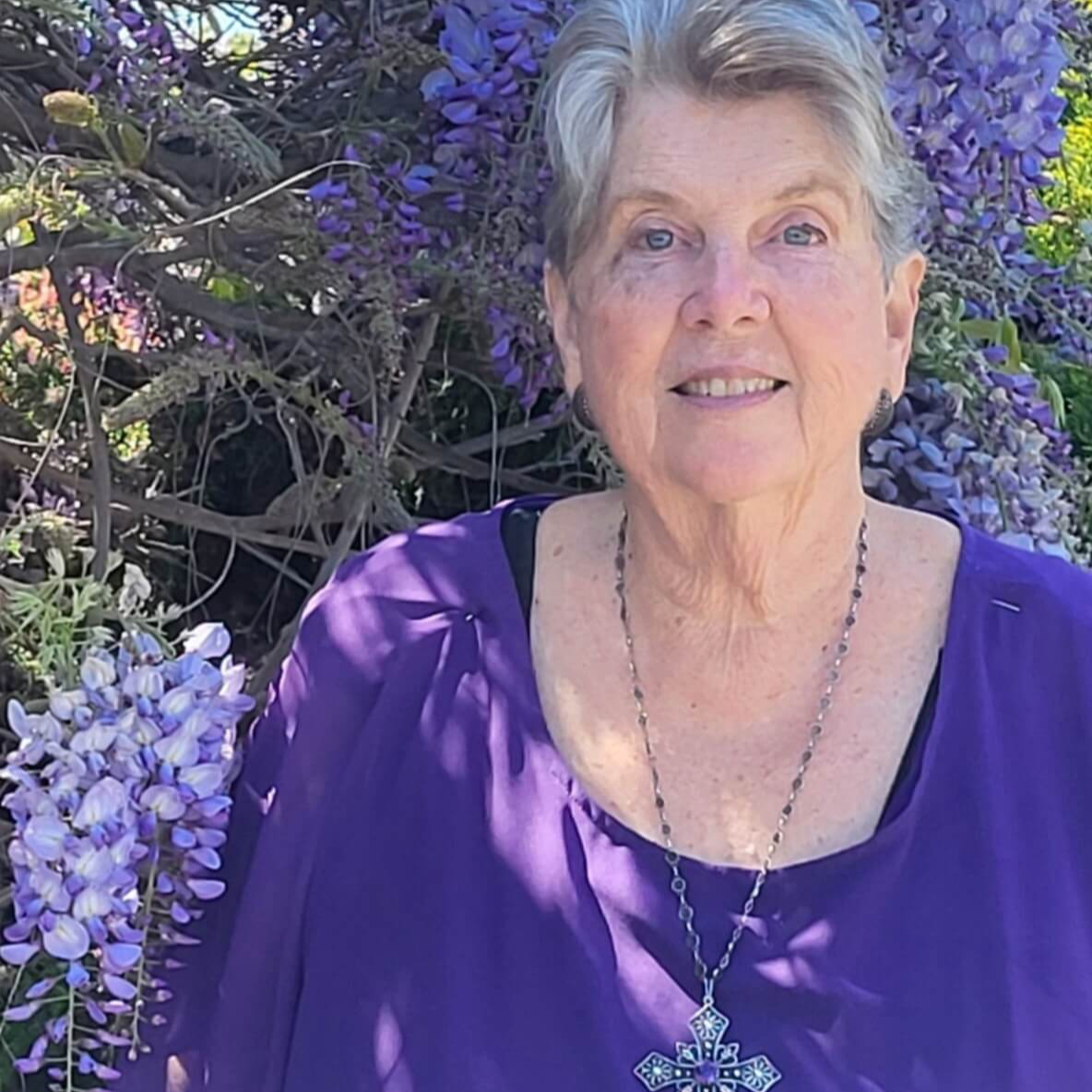
I was traveling in my mid-20s when a friend and I stopped for lunch. I ordered an iced tea. It tasted profoundly like dish soap. I confided in the person I was lunching with and she said, “send it back”.
I couldn’t imagine it!
“I just won’t drink it,” I said. My friend demanded, “SEND IT BACK.” So, in my mousiest voice, I told the waiter, “This tea doesn’t taste right.” The next tea tasted just fine. So, uh, what WAS in that first tea? It is the first time I remember learning to speak up for myself.
As a child of the 1950s, I was part of a generation raised to be ‘seen and not heard.’ I was raised to be compliant. It’s not until my 70s I’ve gained the perspective on how I unlearned the immediate YES and leaned into the fine art of saying NO. And then a YES with intention.
Around the same time in my 20s, I worked at a not-for-profit agency serving adults who were diagnosed with autism. I came up with a brilliant idea. It’s so long ago that I don’t remember the brilliant idea, but whatever it was, I took it to the boss. After I explained it, he said NO. Well, that was that.
After a week or so the boss came to me and asked why I hadn’t pursued my brilliant idea with him. I was in shock. “You said no.” He said in his family when someone came to Dad with an idea, Dad always said NO. Then the child had to come back with an improved plan or just keep pestering Dad until he said yes.
“Well,” I said, “In my family, No meant NO.”
Understanding when to say yes and when to say no is an art, not a science and it’s not something that can be quantified. There’s no scientific research on how to say no. And now, at 76, you’d never guess that there was ever a time that I couldn’t say no.
In my 40s, I was offered the job of my dreams. My years of service and my education had me primed for an executive director position in a program serving adults with disabilities. The CEO of a respected organization in Sacramento called and offered for me to work with her for two years then take her position when she retired. It was everything I had ever hoped for. But my husband had just had back surgery and a move to Sacramento seemed impossible. I made the toughest call of my life and told her no. But I did not resent it. It was the best decision for my family. No was just the right answer. Sometimes the no comes easy. Sometimes it’s agony.
Saying no was also agony when surgeons wanted to do a complicated surgery on my daughter. They were volunteer surgeons at a respected children’s hospital. Who was I to say no to them? I was young and doctors were on a very high pedestal in my mind. However, I said no to the surgery. I later found out the children who had the surgery never walked again. The surgeons’ theory proved to be false. If I had not been practicing saying no, I would not have been strong enough to stand up to the doctors.
Life and obligations continue to creep up on you. Over the years I was always honored when an organization asked me to join a board or be an officer. I found myself working a full-time job, dealing with a husband with multiple health issues and having organizational obligations on many evenings and most weekends. My husband eventually asked, “Are you avoiding being around me? You are never here. Am I a priority to you?”
At the time I was angry at him. After all, I was doing all these good deeds and being SO helpful! After some reflection, I realized he was right. I was so busy I had forgotten where I needed to be. I looked at each organization and said NO to all but a few. It was my own version on YES. Instead of being overwhelmed, I was just whelmed! I made my husband my top priority and I’m glad I did because my time with him went by fast.
When I was overwhelmed, I would look to my purpose in life. Purpose for each person is different. In my case, I think it boils down to helping others. If I know my life purpose, then it’s easier to judge when an opportunity is aligned.
A particular moment of purpose that I remember is when I went to a local company who had hired one of my clients who was deaf. I was meeting with her and her supervisor to try to resolve some issues. My client felt people were talking about her. So the supervisor agreed we could teach her co-workers some sign language. They were thrilled to be able to communicate with her and it made all the difference. I left feeling like I was fulfilling my purpose in being a Rehabilitation Counselor. I had a few other moments like that in my 20 years of service, but not nearly enough.
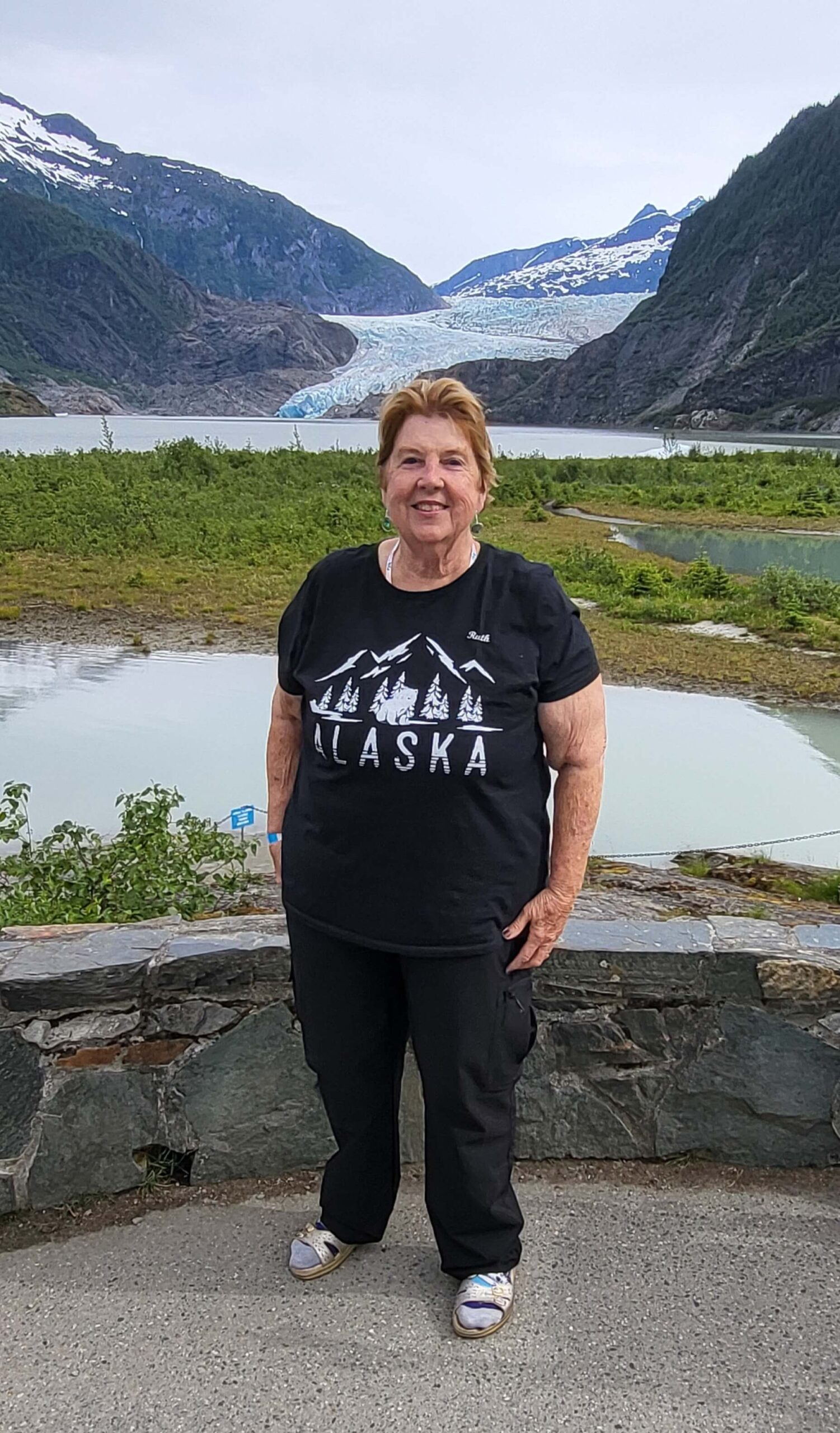
Ruth on Alaska trip
I’ve also learned that closely related to NO is KNOW. I’m old enough to have experiences that have taught me when something is right. I can say NO because I KNOW. That feeling of knowing feels like divine intervention. When I fell in May and broke my shoulder, the paramedics said they were going to sit me up. I said NO. They said they would stand me up. I adamantly said NO. One paramedic said, “Well, Mrs. Jackson, how do you propose we get you to the hospital?” I said, “I don’t know but don’t sit me up or stand me up!” They slipped a blanket under me and carried me to the gurney. After surgery my surgeon said that my humerus was displacing my brachial artery. Any additional movement could have made it burst and I would have bled out there in my front yard. My saying NO had to be divine intervention! I didn’t KNOW about the artery. I just knew I had to say no.
For me, the BIG no’s usually involve a relationship or authority. A BIG NO may be on principle or when something is against the law or maybe when the law needs to be changed. The BIG no’s don’t always work in your favor but, still, you have to take a stand.
Something that Matthew McConaughey wrote in his book “Greenlights” inspired me. He said he refused all rom-com scripts for 24 months. He took a financial hit and an emotional hit but he said he had faith that the right script would eventually come and it did. His strong NO led to the absolute YES.
And that’s why I work on my NO’s – so I will have better YESES.
Now I automatically consider the impact the decision will make on my family, friends and loved ones. I think about my purpose. Do I need to protest? What effect it will have on my peace of mind.
Because saying no is an art and not a science, I had dreamed of going to Alaska since I was 10. My aunt offered me a trip but it never happened. Now I felt the urgency of making it happen. The SCIENCE of saying no, the practicality of saying no, would say I didn’t have the money, the time, the youth or the health to make the trip. The ART of saying no allowed me to make a decision that didn’t necessarily make sense. I was able to go to Alaska in the summer of 2024 and have the time of my life.
The benefit of practicing saying no for most of my life is now my yeses are strong. I have had life experience that helps me make confident decisions. I have learned the consequence of not saying no when it needs to be said. I have navigated using no to strengthen or protect my family. I have used no to protect me from being overwhelmed. I have used my purpose to steer me down the rough waters of life. I have protested when necessary and I have used no to protect my peace of mind. I wish for you a practice of saying no to give you some very strong yeses in 2026.
Ruth Jackson is the mother of two perfect daughters and four delightful grandchildren. For 50 years Ruth worked with people who have a disability. For 35 of those years she has been and currently is a CARF (Commission on Accreditation of Rehabilitation Facilities) surveyor. She is on the board of directors of Options in San Luis Obispo, California and of Unity Church. She enjoys travel; gardening; sewing and writing. She can be contacted at[email protected]
Thank you for sharing such good words of wisdom! Congratulations on your impactful career advocating and assisting people with disabilities!
Dear Ruth, You are an amazing writer and an amazing friend. I so enjoy your presence whenever we have the opportunity to connect. You bring out the JOY in my heart and remind me that laughter is therapeutic. Thank you for the opportunity to read your writtings just now. Most of all, thank you for your friendship. Blessed be to you from me.
wow. beautiful! I feel the same about you!
I loved reading this – It resonated because I have often said “yes” to be helpful – and it wasn’t the correct response for the situation. This article was a gentle yet strong reminder about the importance – (and sometimes the life-saving) of being true to yourself. Thank you. Rita
So glad it was helpful!
Ruth
Ruth is very gifted in many areas. She continues to educate herself and use her writing talents. And she is always willing to share what she has learned. I admire her! We all say “yes” too often just to keep peace or be compliant. Insightful article!
So glad it was helpful!
Ruth
Ruth, I love that inherent in the art and science of saying no (or yes) is a trust in our own counsel – listening to that inner voice that that guides us forward. You are mastering the trust needed to “go with your gut” and be confident that you can benefit in some way (Lessons learned? Rewards to be enjoyed? Personal growth? Crises averted? Who knows?) from doing so. Thank you for the reminder.
Glad you enjoyed it and appreciate the comment!
Ruth
Ruth,
I enjoyed reading every word! You were so right! Especially when we’re younger, it’s so hard to say No! It’s amazing what aging and experience can do for us. You really are a talented writer and always a great communicator!
Thanks for leaving a comment!
Learning how to create healthy boundaries, such as “saying no,” is essential to creating a happy life. Thanks for the great example, Ruth.
Thanks Ruth. Words of wisdom ! I’m still a work in progress! ♥️🙏
You have a beautiful gift for writing Ruth: thank you for sharing your insights and wisdom with us. You are such a bright light! I am so blessed to know you ❤️